Geometry Dash Difficulty Tiers, From Easy to Extreme Demon

The full rating ladder explained: what each difficulty face means, where the demon family starts, and why the community list only ranks one tier of it.

10 rating tiers5 demon sub-tiers

The main ladder

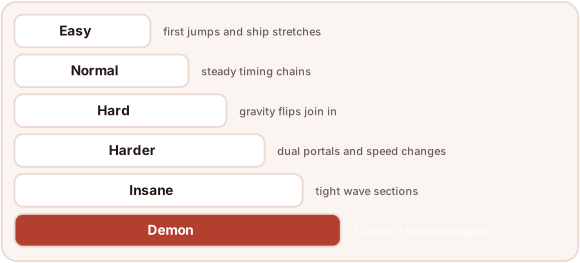
Geometry Dash difficulty ladder illustration
The non-demon ladder: Auto through Insane, each step adding a new mechanical demand.

Geometry Dash rates levels with a ladder of faces, and each step up adds a specific kind of demand rather than just "more of the same". Easy assumes you can jump and fly a spacious ship corridor. Normal chains timings steadily. Hard introduces gravity portals and tighter corridors. Harder mixes speed changes and dual-mode sections. Insane compresses everything - tight wave lanes, frame-strict timings, sections where the camera itself works against you. The official main levels sample this ladder one tier at a time, which is why beating the campaign's later levels is the standard warm-up before demon hunting.

The demon family

Demon sub-tiers from Easy Demon to Extreme Demon
Five sub-tiers inside "demon" - and only the last one makes the community list.

"Demon" is where ratings stop being about an afternoon. Every demon pays the same 10 stars in-game, but the community splits the family into five sub-tiers by real difficulty, and the gaps inside the family dwarf the gaps below it: an Extreme Demon is further from an Easy Demon than an Easy Demon is from Insane. The sub-tiers are community labels rather than separate in-game ratings - which is precisely the gap the demon list fills: it ranks the Extreme Demon tier - and only that tier - into an ordered board of 150.

Sub-tierWhat it feels likeTypical first examplesOn the list?
Easy DemonThe doorway - real commitment, forgiving executionOfficial demons: Clubstep, ToE 2, DeadlockedNo
Medium DemonA steady grind; mechanics lengthenLong-standing community staplesNo
Hard DemonReal mechanics density; stamina mattersClassic hard demon wave levelsNo
Insane DemonWalls everywhere; hundreds of attemptsModern consistency testsNo
Extreme DemonList territory - the game's ceilingAll 150 list levelsYes

The "typical first examples" column is deliberate: the three official demons remain the classic entry points because the campaign teaches you their tricks first. What each stage of the climb asks of your hands is the subject of the roadmap page; what the very top of the extreme tier looks like is the hardest demons page.

Reading faces vs. reading the list

A common confusion: two levels both show a demon face, yet one takes an afternoon and the other takes a year. The in-game face system compresses the entire demon range into one rating - 10 stars, full stop - because it must rate every level in the game with the same ruler. The community list exists to re-ruler just the top: inside "extreme demon", positions 1-150 are themselves a difficulty ladder with a steeper gradient than everything below it combined. That is why players quote list positions the way climbers quote routes, and why this site mirrors the board as a dated, structured page rather than another face chart.

Frequently asked questions

What are all the difficulty faces in Geometry Dash?

The in-game rating ladder runs Auto, Easy, Normal, Hard, Harder, Insane, then the Demon family. Every demon - regardless of sub-tier - is worth 10 stars in-game; the demon faces (Easy through Extreme Demon) express how far up the demon scale a level sits, which is exactly the scale the community demon list ranks.

What is the difference between Insane and Demon?

Insane is the ceiling of normal ratings; Demon is a different class of commitment. Demons demand sustained learning - most players need dozens to hundreds of attempts on even an Easy Demon - while Insane levels are beatable in an afternoon with solid fundamentals. The roadmap page shows the climb in order.

What does an Extreme Demon mean?

Extreme Demon is the top of the demon sub-tier ladder and the only tier the community demon list ranks - the 150 levels on our main board are all extremes. Sub-tiers are community labels, not separate in-game ratings; in-game every demon pays 10 stars.

How many stars do demons give?

Every demon is worth 10 stars in-game, from Easy Demon to Extreme Demon. The sub-tier faces change the icon and the community prestige, not the star payout - one reason list position, not stars, is the real currency at the top.