The Demon Roadmap - From Your First Demon to the List

12345

An ordered plan for Geometry Dash's hardest content: what to play at every stage, what each stage trains, and how to know when you are ready for the next one.

5 stagesFirst demon to list extremes

The five stages

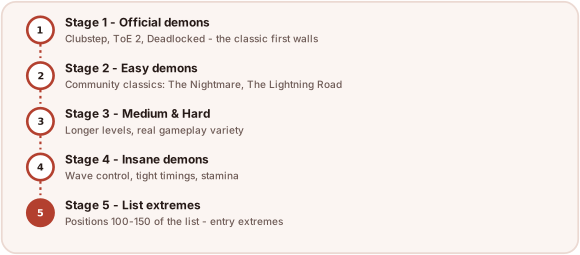
Five-stage roadmap from official demons to list extremes
Each stage is a real goal on its own - and the exit criteria tell you when to move up.
StagePlay thisIt trainsReady to move on when...
1Official demons: Clubstep, ToE 2, DeadlockedLearning that demons are learnableOne of the three is beaten
2Easy demon classics: The Nightmare, The Lightning RoadFull-length runs, stamina, real attemptsEasy demons take days, not weeks
3Medium & hard demons across playstylesMechanic breadth: waves, timings, dualsYou pick levels by fun, not fear
4Insane demons - your first serious training blockConsistency, segment practice, patienceProgress inside a week feels normal
5Entry list extremes - list positions 100-150Everything, at list intensityThe next goal is position 100

Stage 1 - the official three

Clubstep, Theory of Everything 2 and Deadlocked are the built-in demons, and they are the classic starting line for a reason: the campaign's later levels quietly rehearse their tricks, so the jump feels like a step rather than a cliff. Expect your first demon to take real attempts spread over days or weeks - that is not a personal failing, it is the tier working as designed. Beating any one of the three is the standard "I can do demons" milestone, and it unlocks stage 2 psychologically more than mechanically.

Stages 2-3 - breadth before height

The classic easy demons - The Nightmare, The Lightning Road and their long-standing peers - are where full-length demon runs become routine. The mistake to avoid here is climbing too fast: playing only the hardest thing you can barely attempt trains frustration, not skill. Instead, stay a tier below your ceiling and rotate playstyles - a timing level, a wave level, a dual-heavy level. Breadth is what makes stage 4 survivable, because insane demons punish narrow players with exactly the mechanics they skipped.

Stages 4-5 - the list comes into view

Insane demons are the first stage where how you practice matters more than which level you picked: segment the level, grind the two or three sections that kill you, and only then run full attempts. That habit is precisely what list extremes demand. The entry zone is the bottom of the main board - today that means positions near 100 (Decks Dark) at position 100 - and finishing your first list extreme is the real graduation this whole roadmap exists for. From there, the top of the board stops being folklore and starts being a map.

Frequently asked questions

What should my first demon be?

The community classics: the three official demons (Clubstep, Theory of Everything 2, Deadlocked) teach their own tricks through the campaign, and long-standing easy demons like The Nightmare and The Lightning Road are the traditional first completions. Pick whichever one looks fun - finishing any demon matters more than which one.

How long does the climb to extreme demons take?

Realistically, years of on-and-off play - and that is fine. Easy demons take weeks, medium and hard demons take months, insane demons are a serious training block, and entry list extremes (around position 100-150) are a multi-month project for strong players. The roadmap is ordered so each stage is a real, satisfying goal on its own.

How do I train for wave-heavy demons?

Wave control is a skill you build directly: play wave-focused levels a tier below your current goal, practice short segments rather than full runs, and treat your first hundred deaths as the tuition fee. By the time a wave section stands between you and a completion, your hands should already know the answer.

Why start list demons at positions 100-150?

Because the list is difficulty-ordered: position 150 is easier than 100, and both are far more achievable than the top 25. The bottom of the board is the classic entry zone into list-level content - hard enough to be a real achievement, humane enough that progress is weekly rather than yearly.